{contenu}
Why adopt it?
PHP and Javascript are two languages that have greatly improved,
there are also a lot of frameworks and tools, even AIs that do the job, right?
Then why should you spend time there?
there are also a lot of frameworks and tools, even AIs that do the job, right?
Then why should you spend time there?
{contenu}
¤ Adaptability to the project and control of the code.
Because it has already been used for any kind of project, because it can be easily modified, or supplemented with other technologies, you are sure you do not encounter any blockage or impossibility during your development.
You are totally master of the code, the components of helPHP are all written in plain language, clear, documented and there is no shadow or useless element (which is not often the case with what AI produces).
You are totally master of the code, the components of helPHP are all written in plain language, clear, documented and there is no shadow or useless element (which is not often the case with what AI produces).
¤ Time
Learning, development, installation, deployment, execution time: we have done our utmost to make you win. Time to execute also means a reduction in resource consumption!
By making maximum use of the capabilities of the environment and languages (such as the PHP8 OPcache) and reducing all redundancy (no unnecessary queries, minimalized and compressed CSS scripts and scripts) helpPHP releases resources very quickly, making them operational for other projects.
By making maximum use of the capabilities of the environment and languages (such as the PHP8 OPcache) and reducing all redundancy (no unnecessary queries, minimalized and compressed CSS scripts and scripts) helpPHP releases resources very quickly, making them operational for other projects.
¤ A rapid deployment base instance.
In addition to basic toolkit, the instance and various scripts installation aid are available in a way to quickly offer all the tools and a starting environment for any project. You install the environment, start the instance, configure it according to your needs, and quickly develop the missing features to create an easily deployable custom version (a simple copy of files, or via a git-to-CI/CD repository, and a copy of the database and it's over).
A long list of features!
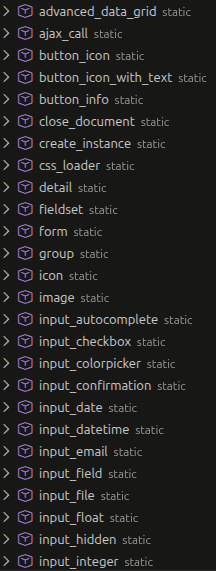
¤ In librairies and utilities:
The "main" librairies propose (most often) to create a global object accessible throughout the application and offering various methods .
The utilities, for their part, perform ad hoc tasks of maintenance or controlled by the libraries (such as launching a system program and monitoring its evolution, or minifying a project and moving it into production mode, or controlling the replication of databases etc...).
The utilities, for their part, perform ad hoc tasks of maintenance or controlled by the libraries (such as launching a system program and monitoring its evolution, or minifying a project and moving it into production mode, or controlling the replication of databases etc...).
All functions and methods are listed Here for the server part.
On the customer side, the Javascript libraries offered are also real gifts, which you will find the list here.
However, a sample of the features (in addition to what has already been mentioned):
- A global support of multilingual displays, for content, but also the user interface, with automatic detection of the browser language.
- All Javascripts and CSSs are reduced to a single compressed and minified file in production.
- Automation of uploads, download, image manipulation and compression, video encoding, and streaming (with anti-download security for videos), with the ability to track the progress of operations (including multiple file upload)
- On the database side, writing on MySQL server master with readout distributed on master and slave, fail-over management, simplified support for simple requests or "prepared queries" with security against injections, preparations and automatic validation of the contents of the forms according to table structures... Etc...
- A fast but robust encryption library to secure trade.
- A REST API that automatically creates itself according to available public methods (do you create a new module? its methods are available on the REST side without additional work!)
- Support for HTML or JSON output that avoids having confused scripts, by manipulating a simple object that describes the display you want and that can be modified whenever you want, and exchanged throughout the application. No need to manipulate the display sequentially.
- A secure session management library that facilitates cloud operation, with SQL or Redis storage.
- Automatic management of user rights and information and its membership in a group, but also of its central connection from one or more computer.
- Easy management of incoming and outgoing REST requests as well as communication via SSH including through a tunnel (also allowing a container to communicate with its host server).
- A very thorough management of the DOM also allowing to run several instances of the same module in the same page without conflicts
- A Javascript animation engine to animate any element or attributes of the interface.
- A collection of widget to create modern interfaces quickly and sometimes automatically
- An input validation engine based on their content type
- An automatic routing system for incoming requests, but also for managing the ajax browsing history.
- Centralization and management of javascript events, and the possibility of assigning multiple responses to a single event.
And many other things in modules that are directly exploited by the instance ....
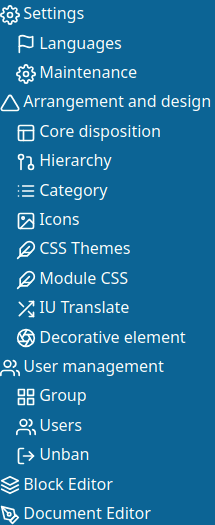
¤ In the instance:
The basic instance which is proposed is a "classical" to start a new project.
It contains all the necessary bases that are common to any project plus some modules to create a website and the designer (like the one you are on at the moment ; ).
What does this body propose?
It contains all the necessary bases that are common to any project plus some modules to create a website and the designer (like the one you are on at the moment ; ).
What does this body propose?
- An installation script, which will configure it, compact it to go into production and various utilities to maintain and control it
- The "core" module, which allows to organize various modules to create a "disposition" of display, but which also manages its display, the display of a module via an internal request and facilitates the display according to the context: for all browsers as well as to facilitate the work of indexing engines or social networks.
- A lightened HTML display, without unnecessary tags, and above all that highlights indexable content to facilitate SEO's work.
- And can be displayed directly in a Cordova, Electron or any kind of webview application.
- Modules to manage connection, users, groups and their rights.
- Language management and various functions and module to translate content and interface elements using LibreTranslate.
- Publishing and previewing CSS (for various screen sizes) with the creation, import and export of themes.
- Creating hierarchical menus but also a category trees to classify content
- The manipulation of the media and their instanciation to avoid duplication
- A notification creation and display system (to track bugs or events you wish to be notified of)
- The creation of documents (pages or other) their preview, their particular CSS, their indexing and their cache. All in multilingual
- The creation of input block with any kind of input field, and the ability to style the administration interface like the resulting public display, each block can then be used in the document creation module or in the one allowing to create decorative elements.
- Creating automatic sitemap for indexing engines
- A module to search and select icons for the design of the UI!
- The ability to include the display of one module in another or to run several instances of the same module in the same display without conflict.
And much more...
But to realize it, I suggest you watch the video "round the horizon" that will allow you to see a little bit of this.
But to realize it, I suggest you watch the video "round the horizon" that will allow you to see a little bit of this.
TitreRésumé
What are the reasons you can push to adopt it?
Date de création2026-01-06 00:00:00Date de publication2025-10-24 00:00:00

